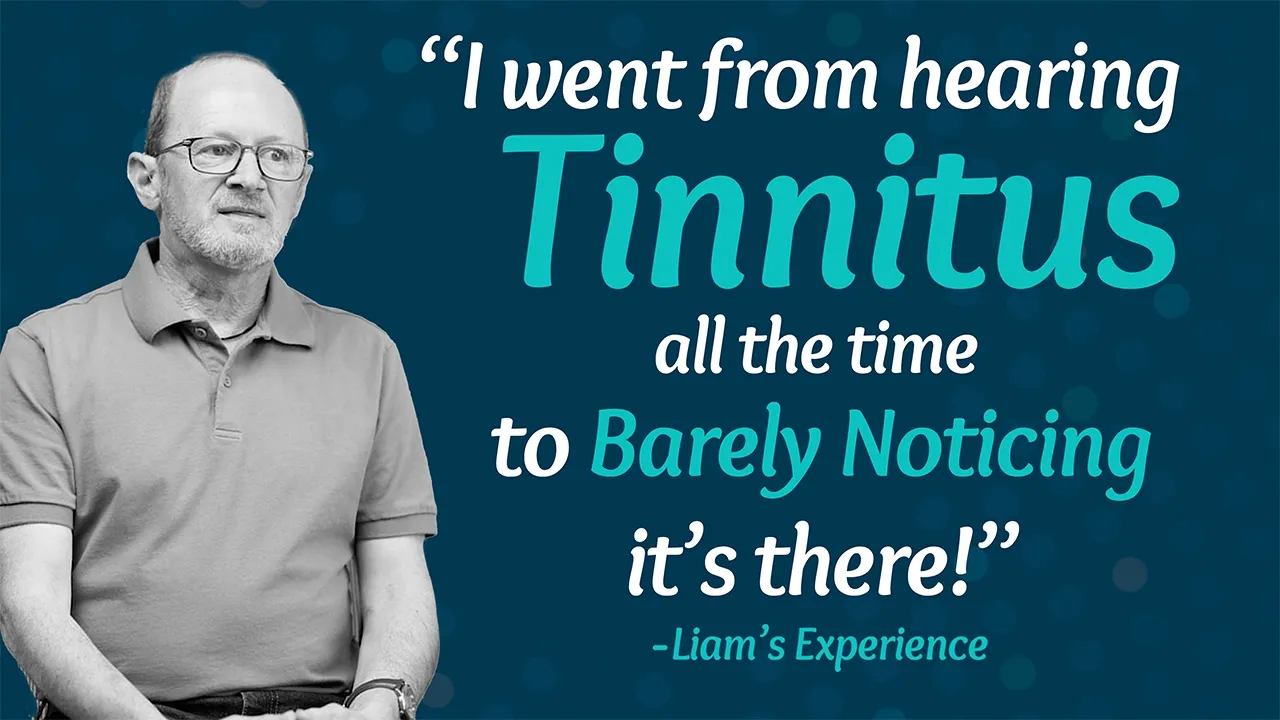
After years of progressively worsening tinnitus, sleep disruption, anxiety, and difficulty hearing in noise, Liam’s Tinnitus Functional Index fell from 47.2 to 4.8 over one year of individualized tinnitus care.
Meet Liam
Liam is a children’s entertainer who performs storytelling, stage work, and balloon twisting. By the time he came to Sound Relief, tinnitus had become difficult to ignore at night, distracting during reading and conversation, and increasingly tied to stress and anxiety. His work also placed him in loud environments where speech understanding could be difficult.
“Going to a restaurant was almost impossible. I couldn’t understand what people were saying, and I didn’t even realize just how bad it was getting.”
Tinnitus Clinical Case Summary
Treating clinicians
Dr. Leah Mitchell, Au.D., CH-TM and Dr. Kelsey Harris, Au.D., CCC-A, CH-TM
Patient
Liam, age 56 at initial evaluation
Primary concerns
Constant high-pitched tinnitus, predominantly left-sided; difficulty falling asleep; anxiety and stress related to tinnitus; difficulty understanding speech in noise.
Tinnitus history
Approximately 3–4 years of progressively worsening tinnitus. Initially more easily covered by everyday sound, but increasingly intrusive, especially in the evening and at night.
Baseline tinnitus impact
March 13, 2025: TFI 47.2 (moderate problem), 70% awareness, 40% annoyance. Hearing Handicap Inventory screening was suggestive of a moderate hearing handicap.
Audiological findings
Clear otoscopy and normal middle-ear function bilaterally. Normal-to-mild sloping sensorineural hearing loss bilaterally. Word recognition: 100% right and 96% left at 55 dB HL. Initial QuickSIN on the right showed mild SNR loss. Tinnitus pitch match: 2800 Hz at 21 dB.
Management plan
Bilateral amplification with tinnitus sound therapy, TRT-based education/counseling, CBT-informed coping strategies, hearing protection for excessive noise, and structured follow-up with repeat TFI monitoring.
5-month outcome
August 13, 2025: TFI 11.2, awareness 10%, annoyance 0%. Liam reported that he did not notice tinnitus with the devices and sometimes could not hear it even when intentionally listening for it. Device use averaged 14 hours/day.
12-month outcome
March 5, 2026: TFI 4.8, awareness 10%, annoyance 0%. Liam reported less stress and anxiety, rare tinnitus awareness with devices, and better hearing in restaurants. Device use averaged 13 hours/day.
Most recent annual
Tinnitus remained well managed and hearing thresholds were stable bilaterally. Liam continued consistent device use and used supplemental sound, including pink noise, when devices were removed. Speech-in-noise difficulty remained an area for monitoring.
Presenting Concerns: When the Sound Became Hard to Ignore
Liam described a high, monotone tinnitus that had developed gradually over several years and was most prominent in the left ear. Earlier in its course, everyday background sound and music could often cover it. Over time, that became less reliable, and by early 2025 the tinnitus had become difficult for him to ignore.
His baseline history documented tinnitus awareness for roughly 70% of the day, with symptoms becoming especially noticeable in the evening. He had experimented with masking sounds and found some benefit, but the tinnitus continued to interfere with sleep, concentration, and his ability to relax.
“It was really difficult for me to focus on people because I was so distracted. I was having a hard time falling asleep, I was tense all the time, which was making me grouchy all the time.”
When Tinnitus Began Affecting Sleep, Focus, and Mood
At his initial evaluation, Liam reported difficulty falling asleep and was using hydroxyzine to support sleep. He also described tinnitus as a trigger for anxiety and noted that reading could become difficult because his attention repeatedly returned to the sound.
Liam also worked frequently in loud environments as a balloon artist and entertainer. He had recently begun using hearing protection for work events, where loud children, music, and balloon popping could add to his daily sound exposure.
A Tinnitus Evaluation That Looked at the Whole Picture
The initial evaluation assessed not only what Liam heard, but how often he noticed it, how much it bothered him, how it affected sleep and concentration, and whether hearing difficulty was contributing to his daily communication problems. This distinction mattered because Liam’s audiogram showed only mild hearing loss, while his functional complaints in restaurants, classrooms, and other noisy settings were much more noticeable to him.
“For me, finding out about the mechanics of how tinnitus works, just realizing that there’s something that can be done about it, that was honestly groundbreaking for me.”
Diagnostic Evaluation
Tinnitus history
Constant high-pitched tinnitus developing over approximately 3–4 years, bilateral by history but predominantly left-sided; increasingly difficult to mask and most intrusive later in the day.
Validated outcome measure
TFI 47.2 at baseline, with 70% awareness and 40% annoyance. This falls in the moderate-problem range for TFI interpretation.
Otoscopy
Clear bilaterally.
Tympanometry
Normal tympanic membrane mobility, middle-ear pressure, and ear-canal volume bilaterally.
Pure-tone audiometry
Normal-to-mild sloping sensorineural hearing loss bilaterally.
Word recognition
Right: 100% at 55 dB HL. Left: 96% at 55 dB HL.
Speech-in-noise
Initial QuickSIN on the right showed mild SNR loss (3–7 dB range). Most recent annual QuickSIN was 6 dB SNR loss.
Tinnitus-specific measure
Pitch match at 2800 Hz, documented at 21 dB.
Functional hearing screen
Hearing Handicap Inventory screening result suggestive of a moderate hearing handicap.
Clinical Findings: Mild Hearing Loss, Significant Functional Impact
Liam’s case is a useful example of why objective audiometric data alone does not fully describe a patient’s listening experience. His thresholds showed normal-to-mild sensorineural hearing loss, yet he reported meaningful difficulty following speech in restaurants and classroom-like settings, hearing people behind him, and correctly interpreting speech in noise.
Tinnitus added another layer of difficulty by competing for attention and increasing distress. These interacting factors contributed to Liam’s listening difficulties; the case does not establish that tinnitus directly prevented him from hearing. His later improvement therefore needs to be interpreted across several domains: tinnitus burden, emotional response, hearing access, coping skills, and communication function.
Clinical Interpretation
Liam’s baseline TFI of 47.2 documented a moderate tinnitus-related functional problem. The 2024 VA/DoD tinnitus guideline supports validated outcome measures such as the TFI, education and counseling, hearing aids when hearing loss is present, therapeutic use of sound, and CBT provided by a trained professional for bothersome tinnitus. NICE guidance also supports assessment, amplification when appropriate, and psychological interventions for tinnitus-related distress, while making no practice recommendation for sound therapy. In Liam’s case, the treatment plan combined these elements rather than relying on a single intervention.
Because Liam also had anxiety, TMJ symptoms, migraine history, multiple sclerosis, and substantial occupational noise exposure, the available information does not establish a single cause for his tinnitus or later fluctuations. Instead, follow-up visits documented triggers and patterns so Liam could better understand and respond to them.
Treatment Plan and Rationale
Amplification
Bilateral prescription hearing devices were used to address documented hearing difficulty and improve access to environmental and speech sounds.
Sound therapy
Ear-level tinnitus sound therapy was adjusted over time for balance and comfort. Liam also used a bedside sound machine and later supplemental sounds such as pink noise when devices were removed.
Education / TRT
Structured tinnitus education and TRT-based lessons focused on understanding tinnitus, sound enrichment, expectations, triggers, and self-management.
CBT-informed coping
Liam was already using CBT techniques for anxiety and applied compatible skills to tinnitus management, including deep breathing, attention shifting, compassion exercises, mindfulness, and progressive muscle relaxation.
Noise management
Hearing protection was recommended for excessive noise exposure, particularly relevant to Liam’s work in loud entertainment environments.
Follow-up
Regular follow-up visits included repeat TFI measurement, programming changes, fit adjustments, hearing-aid maintenance, and review of tinnitus-management lessons.
Early Treatment: Improvement Without an Overnight Fix
At his April 2025 follow-up, Liam was already noticing benefits from amplification, including hearing bird songs he had not been hearing before. At the same time, tinnitus was still variable. He reported a particularly difficult “squealing” day, used a noise machine for sleep, and continued progressive muscle relaxation through the Calm app.
The visit also shows the practical side of tinnitus care: the right device fit needed attention, sound-therapy levels were rebalanced, the sound-therapy ceiling was increased, and additional tinnitus lessons were assigned. The goal was not simply to hand Liam devices, but to keep adjusting the plan as his experience changed.
Recognizing Triggers and Building a Toolbox
By May 2025, Liam described substantial progress. He reported no longer perceiving tinnitus in the right ear and said the remaining left-sided tinnitus was less intrusive, especially during conversation. He also began identifying patterns: fatigue and TMJ flare-ups could increase tinnitus intensity, and he noticed tinnitus changes around his migraine treatment cycle.
Rather than treating every fluctuation as treatment failure, Liam learned to connect symptoms with context and use a broader set of coping tools. Those included a bedside sound machine, mindfulness, breathing exercises, progressive muscle relaxation, compassion exercises, and deliberate changes in attentional focus.
“Having a toolbox full of things I can try — deep breathing, progressive muscle relaxation, all the other things I learned — it’s good to have that. The more of those tools you have, the better off you’ll be in the long run.”
Longitudinal Outcomes
Liam’s outcome is especially useful because the improvement was measured repeatedly rather than inferred from a single testimonial. His TFI fell from 47.2 at baseline to 11.2 by August 2025 and to 4.8 by January 2026. By March 2026, the TFI remained 4.8 while awareness was 10% and annoyance was 0%.
Mar. 13, 2025
TFI: 47.2 · Awareness: 70% · Annoyance: 40%
Moderate TFI impact; sleep difficulty, anxiety, concentration problems, and difficulty hearing in noise.
Aug. 13, 2025
TFI: 11.2 · Awareness: 10% · Annoyance: 0%
Never noticed tinnitus with devices; sometimes could not hear it even when trying. Data logging: 14 hr/day.
Jan. 5, 2026
TFI: 4.8 · Awareness: 20% · Annoyance: 10%
Changing-focus exercises helpful; loud work settings could still aggravate tinnitus. Data logging: 14 hr/day.
Mar. 5, 2026
TFI: 4.8 · Awareness: 10% · Annoyance: 0%
Rarely heard tinnitus with devices; less stress/anxiety; better hearing in restaurants; continued deep breathing and attention-shifting. Data logging: 13 hr/day.
Most recent annual
Tinnitus remained well managed; thresholds stable bilaterally; consistent device use; residual speech-in-noise difficulty monitored. QuickSIN: 6 dB SNR loss.
From baseline to the sustained 4.8 score, Liam’s TFI decreased by 42.4 points, an 89.8% reduction. For context, the original TFI validation work proposed a 13-point decrease as a preliminary threshold for meaningful individual improvement, and later research emphasizes interpreting score change together with the patient’s own report of benefit.
What Changed Functionally
The numbers aligned with Liam’s daily experience. By August 2025, he reported that he never noticed tinnitus while wearing the devices and sometimes could not hear it even when intentionally trying to find it. Data logging showed approximately 14 hours of daily device use.
By March 2026, he reported less stress and anxiety, better hearing in restaurants, and rare awareness while wearing the devices. When tinnitus did become noticeable, he often identified a likely trigger and had a strategy to respond. He continued practicing deep breathing and changing-focus exercises and averaged about 13 hours of device use per day.
“The majority of the day I don’t notice my tinnitus at all, and it’s been such a 180 from where I was day one.”
Most Recent Annual Follow-Up
At his most recent annual visit, Liam continued to describe his tinnitus as well managed and said he had made significant progress since starting treatment. Hearing thresholds remained stable bilaterally, and device data continued to show consistent use. He also used other sounds, including pink noise, when he removed the devices.
The visit also documented an important residual issue: understanding speech in background noise could still be difficult, especially while making balloons in restaurants and interacting with children in noisy settings. QuickSIN measured a 6 dB SNR loss. We reviewed that ongoing difficulty with Liam, and it remains an appropriate target for hearing-management follow-up even though the tinnitus itself is well controlled.
Why This Case Matters Clinically
Liam’s case demonstrates that successful tinnitus care does not need to mean that the auditory perception disappears permanently. For Liam, meaningful progress included less awareness, little or no annoyance, better communication, lower stress, and confidence in managing occasional flare-ups. Sleep and concentration were also important concerns assessed during care.
It also illustrates the value of longitudinal measurement. A testimonial alone could say Liam felt better. Repeated TFI scores, awareness and annoyance estimates, hearing data, treatment adjustments, and device-use data show how that improvement developed and whether it persisted.
Patient Perspective
“I wasn’t just another patient, I wasn’t a rubber stamp. I felt very validated, knowing I wasn’t alone in the process.”
“There is hope. There are things you can do. You’re not subject to this, like, ‘Oh well, I have to live with it.’ You can make that change in your life, and you’ll be so happy that you did, because life is so much better.”
Limitations of This Case
This report describes the experience of one patient and should not be interpreted as evidence that the same combination of interventions will produce identical outcomes for others. Tinnitus is heterogeneous, and Liam had several potentially relevant coexisting factors, including anxiety, TMJ symptoms, migraine history, multiple sclerosis, and occupational noise exposure. The case documents associations and treatment response over time but does not establish a single cause for his tinnitus or prove which individual component of care produced the observed improvement.
Clinical Takeaway
Liam entered care with a TFI of 47.2, 70% tinnitus awareness, 40% annoyance, sleep difficulty, anxiety, and meaningful communication problems in noise. Over the following year, an individualized plan combining amplification, therapeutic sound, tinnitus education, repeated follow-up, and CBT-informed coping strategies was associated with a sustained TFI of 4.8, awareness of 10%, and no annoyance by March 2026. His most recent annual visit continued to describe tinnitus as well managed, while appropriately recognizing residual speech-in-noise difficulty as a separate area requiring ongoing hearing care.
Liam took an active and open-minded approach to his care. He did not view success in tinnitus treatment as requiring a cure. He understood that tinnitus management can improve quality of life without requiring a cure or the complete elimination of tinnitus. He was open to learning and practicing new tools to help manage his tinnitus. Alongside his individualized treatment plan, Liam consistently used his devices, practiced coping strategies, and invested time in learning to manage his symptoms.
Clinical References
VA/DoD. Clinical Practice Guideline for Tinnitus. 2024. Evidence-based recommendations for tinnitus evaluation, validated outcome monitoring, education, hearing aids, therapeutic sound, and behavioral/mental-health support.
National Institute for Health and Care Excellence (NICE). Tinnitus: assessment and management (NG155). Includes recommendations on audiological assessment, TFI use, amplification, and stepped psychological interventions for tinnitus-related distress.
Meikle MB, Henry JA, Griest SE, et al. The Tinnitus Functional Index: development of a new clinical measure for chronic, intrusive tinnitus. Ear Hear. 2012;33(2):153-176. DOI: 10.1097/AUD.0b013e31822f67c0.
Henry JA, Thielman EJ, Zaugg T, Griest S, Stewart BJ. Assessing Meaningful Improvement: Focus on the Tinnitus Functional Index. Ear Hear. 2024;45(3):537-549. DOI: 10.1097/AUD.0000000000001456.
Fuller T, Cima R, Langguth B, et al. Cognitive behavioural therapy for tinnitus. Cochrane Database Syst Rev. 2020;1:CD012614. DOI: 10.1002/14651858.CD012614.pub2.
Kam ACS. Efficacy of Amplification for Tinnitus Relief in People With Mild Hearing Loss. J Speech Lang Hear Res. 2024;67(2):606-617. DOI: 10.1044/2023_JSLHR-23-00031.
CARE Case Report Guidelines. Structural framework for clinical timeline, findings, intervention, follow-up/outcomes, patient perspective, limitations, and informed consent.
Clinical Review
Treating audiologists: Dr. Leah Mitchell, Au.D., CH-TM and Dr. Kelsey Harris, Au.D., CCC-A, CH-TM
Clinical review for publication: Dr. Abby McMahon, Au.D., CH-TM
Reviewed: November 12, 2026