
Hearing Healthcare Is Critical to Healthy Aging
Hearing is sometimes treated as something separate from overall health. It should not be.
Healthy hearing supports communication, relationships, social engagement, independence, safety, and quality of life, while untreated hearing loss is associated with cognitive decline, dementia risk, social isolation, depression, and an increased risk of falls.
The relationship between hearing and healthy aging has become increasingly important. In the NIH-funded ACHIEVE trial, hearing intervention did not slow cognitive decline across the entire study population, but among older adults at increased risk for dementia, the rate of cognitive decline was nearly 50 percent lower over three years in the group receiving hearing intervention.
For us, the takeaway is simple: Hearing deserves a place in the conversation about healthy aging and whole person healthcare. A patient does not need to be struggling significantly for their hearing to warrant attention.

Sometimes the Right Answer Is Both
Audiologists and ENTs are not competing referral destinations. We are different parts of the same healthcare team.
An audiologist can define the type and degree of hearing loss, evaluate speech understanding and auditory function, assess and treat tinnitus, and identify findings that may require medical investigation.
An ENT can diagnose and medically or surgically manage diseases and disorders of the ear.
At Sound Relief, we respect that line, and if something is outside our scope, we do not try to make it fit within it. We make the appropriate referral and help the patient understand why.
That is an important part of being a good referral partner.
What Should Your Patient Expect from an Audiology Referral?
Regardless of where you refer a patient, we believe comprehensive audiologic care should include more than a quick hearing screening.
A thorough evaluation should consider the patient's medical and hearing history, medications, noise exposure, communication concerns, tinnitus, sound sensitivity, and other factors that may influence auditory health.
Depending on the patient's needs, our testing may include:
Visual examination of the ear canals and eardrums via video otoscopy
Tympanometry and middle ear assessment
Pure tone audiometry in a soundproof booth
Speech recognition testing
Speech in noise testing
Tinnitus pitch and loudness matching
Loudness discomfort levels (LDLs)
Otoacoustic Emissions (OAEs)
Additional diagnostic testing when clinically appropriate
A clear explanation of the results
Personalized recommendations based on the patient's needs and goals
At Sound Relief, a comprehensive hearing evaluation generally lasts 90 minutes because obtaining meaningful answers requires more than determining the softest tones someone can hear; we want to understand how that person hears in the real world.
What Makes Sound Relief Different - We Practice Audiology, Not Transactions.
We Practice Audiology, Not Transactions.
Technology can be an important part of hearing healthcare, but technology alone is not healthcare. Our medical model combines advanced diagnostic testing, experienced doctors of audiology, best-practice treatment protocols, patient education, counseling, technology when appropriate, and ongoing follow-up care. A patient should never feel as though their referral simply led them to a hearing aid sales appointment.
Our responsibility is to help answer three simple questions:
What is happening?
How is it affecting the patient?
What should happen next?
The answer will not be the same for every patient. Some may need treatment, some may simply need monitoring, and others may need a referral for additional medical care.
Most importantly, we want every patient to leave with reassurance, a clear understanding of what we found, and confidence in their next steps.
When to Refer for Hearing Loss
You do not need to wait for a patient to tell you, "I can't hear." Consider referring patients who:
Report difficulty understanding speech, especially in background noise
Frequently ask others to repeat themselves
Say people sound like they are mumbling
Increase television or phone volume
Have family members expressing concern about their hearing
Experience tinnitus
Have sound sensitivity, hyperacusis, or misophonia
Have a history of significant occupational or recreational noise exposure
Take or have taken medications with potential ototoxic effects
Demonstrate unexplained communication difficulties
Have known hearing loss that has not been evaluated recently
Patients who are 50 and older should include routine hearing assessments to ensure healthy aging
Anyone with a family history of dementia or Alzheimer’s disease
Anyone being assessed for or concerned with their cognitive health
Sometimes the patient will notice a change in their hearing; sometimes it’s their spouse or children who notice it first. And sometimes hearing changes are subtle enough that neither realizes how much communication has changed until we test it.

How Often Should Adults Have Their Hearing Tested?
There is not one testing schedule that is appropriate for every adult.
Current clinical guidance supports offering hearing screening to adults beginning around age 50, or earlier when a patient reports hearing concerns, with screening approximately every 1 to 3 years, depending on the individual. Patients with known hearing loss or reported changes require more routine audiologic follow-up.
At Sound Relief, we believe in establishing a baseline rather than waiting until hearing difficulty becomes obvious. Testing sooner is particularly important when a patient reports a change in hearing, tinnitus, difficulty understanding speech, significant noise exposure, or when family members have begun noticing communication difficulties.
In other words, you do not need to wait for significant hearing loss to justify an audiology referral.
When to Refer for Tinnitus
Tinnitus is one of the most common reasons patients are referred to Sound Relief. As it is often the first sign of changes within the auditory system, it deserves a thorough evaluation, especially by a team with our depth of experience in this specialty.
A patient should be considered for a comprehensive tinnitus evaluation when tinnitus is:
Of recent onset
Affecting sleep
Persistent
Interfering with concentration
Creating anxiety or emotional distress
Associated with sound sensitivity
Affecting work or relationships
Becoming increasingly intrusive
Accompanied by hearing difficulty
Simply concerning to the patient
An audiologist can evaluate the patient's hearing and tinnitus and help determine appropriate next steps. Certain presentations, including pulsatile tinnitus and other medically concerning findings, may also warrant additional medical evaluation.
Most importantly, patients should not automatically be told that nothing can be done.
There are evidence-based strategies that can significantly reduce the impact tinnitus has on a person's life.
How Does Sound Relief Treat Tinnitus?
One of the most important things for physicians to understand about tinnitus is that there is no single treatment that is right for every patient.
Tinnitus can differ dramatically from one person to another. Its perceptual characteristics, hearing status, emotional response, sleep disruption, nervous system involvement, and effect on daily life can all influence the treatment approach.
That is why treatment at Sound Relief begins with a comprehensive tinnitus evaluation rather than a predetermined solution.
About 50% of patients with tinnitus find relief simply by restoring the brain's missing auditory input with prescription hearing aids. The other half of patients need something more, which is where we are more sophisticated than most other audiology practices in our approach to tinnitus. Many of our patients benefit from our proprietary Sound Relief Method®, while others have benefited greatly from Frequency Health’s precision sound therapy.

The Sound Relief Method®
For patients with persistent bothersome tinnitus that has become intrusive, distressing, or disruptive to everyday life, we use a comprehensive approach that addresses more than the sound itself.
The Sound Relief Method® is designed to address the entire tinnitus distress cycle, including auditory perception, attention, emotional response, nervous system activation, and the behaviors that can reinforce the brain's reaction to tinnitus.
Based on the individual patient, treatment may include:
Personalized, prescriptive sound therapy
Educational counseling
Tinnitus Retraining Therapy (TRT) principles
Nervous system regulation
CBT-based brain retraining strategies
Lifestyle and behavioral strategies
Prescription hearing aids
Ongoing guidance and follow-up with an experienced audiologist
The objective is not simply to cover tinnitus with another sound; instead, we aim to change the patient's relationship with tinnitus, so the brain stops treating it as something important, threatening, or deserving of constant attention. For many patients, that is the pathway toward meaningful, long-term improvement.
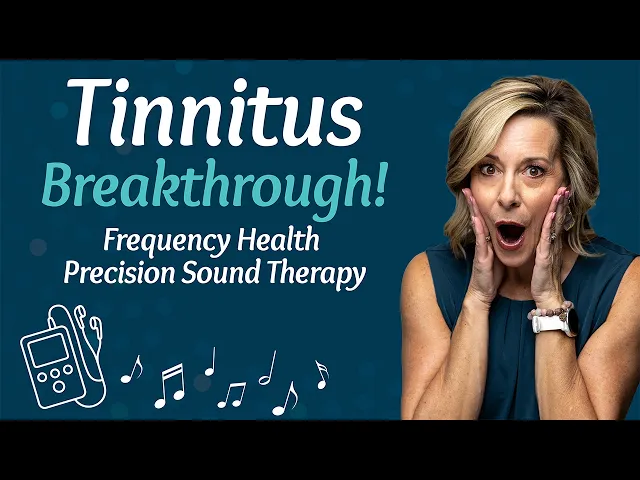
Frequency Health Precision Sound Therapy
Sound Relief also offers Precision Sound Therapy from Frequency Health for appropriate tinnitus patients. This is a different approach to sound therapy.
Traditional audiometric testing typically measures hearing at a relatively small number of standard frequencies. Frequency Health uses its Tinnitogram™ technology to evaluate hearing across 67 frequency bands, creating a much more detailed picture of the patient's auditory profile.
That information is then used with REVE134™ technology to develop a highly individualized sound therapy program targeted to specific frequency regions identified during testing.
Rather than using sound primarily to distract the brain away from tinnitus, Precision Sound Therapy delivers customized, very low-level auditory stimulation based on the patient's individual frequency profile to more precisely target the areas associated with their tinnitus.
For the right candidate, it gives our audiologists another tool to consider when building a tinnitus treatment plan. We determine candidacy after a comprehensive evaluation and recommend it when we believe it fits the patient's tinnitus profile, hearing, symptoms, and treatment goals.
The Importance of Multiple Treatment Options
If every tinnitus patient who walks into a practice receives the exact same treatment recommendation, we should probably ask why, because tinnitus is far too complex for a one-size-fits-all approach.
One patient may benefit most from prescription hearing aids alone, while others may need a comprehensive habituation and brain retraining program, Frequency Health Precision Sound Therapy, a combination of approaches, or a medical evaluation before tinnitus treatment should begin.
Our job is not to fit the patient into the treatment we happen to offer. Our job is to understand the patient well enough to recommend the best treatment for them. That distinction is at the heart of patient care at Sound Relief.
Our Commitment to You
You have worked hard to earn your patients' trust, and we have worked hard to earn the trust of the healthcare professionals who refer to us. We will never take either for granted.
When you refer a patient to Sound Relief, our job is to provide an exceptional patient experience, conduct a thorough clinical evaluation, communicate clearly, make responsible recommendations, and help the patient determine the right next steps.
References
Lin, F. R., & Ferrucci, L. (2012). Hearing loss and falls among older adults in the United States. Archives of Internal Medicine, 172(4), 369–371. https://doi.org/10.1001/archinternmed.2011.728
Livingston, G., et al. (2024). Dementia prevention, intervention, and care: 2024 report of the Lancet standing Commission. The Lancet, 404(10452), 572–628. https://doi.org/10.1016/S0140-6736(24)01296-0
Yeo, B. S. Y., et al. (2025). Hearing loss and falls: A systematic review and meta-analysis. JAMA Otolaryngology–Head & Neck Surgery, 151(5), 485–494. https://doi.org/10.1001/jamaoto.2025.0056
Genther, D. J., et al. (2013). Association of hearing loss with hospitalization and burden of disease in older adults. JAMA, 309(22), 2322–2324. https://doi.org/10.1001/jama.2013.5912
Lin, F. R., & Albert, M. (2014). Hearing loss and dementia — who is listening? Aging & Mental Health, 18(6), 671–673. https://pmc.ncbi.nlm.nih.gov/articles/PMC4075051/
Cheng, Y.-F., et al. (2021). Risk of early-onset dementia among persons with tinnitus: A retrospective case-control study. Scientific Reports, 11, Article 13399. https://doi.org/10.1038/s41598-021-92802-y
Henry, J. A. (2022). Sound therapy to reduce auditory gain for hyperacusis and tinnitus. American Journal of Audiology, 31(4), 1067–1077. https://doi.org/10.1044/2022_AJA-22-00127
Vitale, T. N. (2019). Screening for hearing loss: Physician attitudes and practice [Doctoral dissertation, CUNY Graduate Center]. CUNY Academic Works. https://academicworks.cuny.edu/gc_etds/3169/
Hori, K., et al. (2025). Social outcomes among adults with hearing aids and cochlear implants: A systematic review and meta-analysis. JAMA Otolaryngology–Head & Neck Surgery, 151(8), 806–816. https://doi.org/10.1001/jamaoto.2025.1777
Kaitiaria, R., et al. (2022). Outcomes from 7 years of a direct-to-audiology referral pathway. Irish Journal of Medical Science, 192(3), 1341–1347. https://doi.org/10.1007/s11845-022-03145-0
Johns Hopkins University of Medicine. (n.d.). Hearing aids can slow rate of cognitive decline by nearly half. Johns Hopkins Giving. https://giving.jhu.edu/story/hearing-aids