Appointments Currently Available | We're Currently Accepting New Patients & Referrals

Appointments Currently Available | We're Currently Accepting New Patients & Referrals

Tinnitus in One Ear

Every tinnitus journey is different, but hearing how others have found relief can make a real difference when you're searching for answers.

Our tinnitus case studies share the experiences of patients who came to Sound Relief looking for help and discovered personalised treatment options that improved their quality of life. Explore their stories to learn more about the challenges they faced, the treatment approaches used, and the outcomes they achieved.

Tinnitus in One Ear: How Precision Sound Therapy Helped Brad Reclaim His Sleep and His Life

A patient story from Sound Relief Tinnitus & Hearing Center in Highlands Ranch, Colorado

When Brad first came to our clinic, he was not looking for a diagnosis; he already had one. He arrived carrying the weight of a long, difficult year: relentless ringing in one ear, a benign brain tumor that had been treated with radiation, persistent headaches, and the kind of sleep deprivation that quietly unravels a person's health. What he was looking for was relief. This is the story of how Precision Sound Therapy helped him find it.

Old brick building with archways and windows.

Why does tinnitus in one ear deserve a closer look?

Most tinnitus is bilateral, heard in both ears. Brads was different. "A couple of years ago, I was diagnosed with tinnitus in one of my ears," he recalled. "So, I was recommended to do an MRI to see if there might be a cause of only having it in one ear instead of two."

That instinct was the right one. One-sided, or unilateral, tinnitus is uncommon enough that it warrants imaging to rule out a treatable underlying cause. As our Dr. Julie Prutsman, Au.D., explains, "When we see cases like Brad's, typically an MRI is recommended if we can't identify another reason why just one ear would be affected. It's a small likelihood that anything turns up, but it's important to rule out."

In Brad's case, the MRI did reveal something: a vestibular schwannoma, a benign tumor on the hearing and balance nerve. He underwent radiation, which successfully shrank the tumor to a size of no further concern. By the time he reached our clinic, the tumor was controlled, but the tinnitus had not gone away, and the treatment had left him with persistent headaches.

Old brick building with archways and windows.

Why does tinnitus in one ear deserve a closer look?

Most tinnitus is bilateral, heard in both ears. Brads was different. "A couple of years ago, I was diagnosed with tinnitus in one of my ears," he recalled. "So, I was recommended to do an MRI to see if there might be a cause of only having it in one ear instead of two."

That instinct was the right one. One-sided, or unilateral, tinnitus is uncommon enough that it warrants imaging to rule out a treatable underlying cause. As our Dr. Julie Prutsman, Au.D., explains, "When we see cases like Brad's, typically an MRI is recommended if we can't identify another reason why just one ear would be affected. It's a small likelihood that anything turns up, but it's important to rule out."

In Brad's case, the MRI did reveal something: a vestibular schwannoma, a benign tumor on the hearing and balance nerve. He underwent radiation, which successfully shrank the tumor to a size of no further concern. By the time he reached our clinic, the tumor was controlled, but the tinnitus had not gone away, and the treatment had left him with persistent headaches.

Old brick building with archways and windows.

Why does tinnitus in one ear deserve a closer look?

Most tinnitus is bilateral, heard in both ears. Brads was different. "A couple of years ago, I was diagnosed with tinnitus in one of my ears," he recalled. "So, I was recommended to do an MRI to see if there might be a cause of only having it in one ear instead of two."

That instinct was the right one. One-sided, or unilateral, tinnitus is uncommon enough that it warrants imaging to rule out a treatable underlying cause. As our Dr. Julie Prutsman, Au.D., explains, "When we see cases like Brad's, typically an MRI is recommended if we can't identify another reason why just one ear would be affected. It's a small likelihood that anything turns up, but it's important to rule out."

In Brad's case, the MRI did reveal something: a vestibular schwannoma, a benign tumor on the hearing and balance nerve. He underwent radiation, which successfully shrank the tumor to a size of no further concern. By the time he reached our clinic, the tumor was controlled, but the tinnitus had not gone away, and the treatment had left him with persistent headaches.

The vicious cycle of tinnitus

For Brad, the tinnitus and the headaches reinforced one another. "Getting to sleep when you have a headache is hard enough," he said. "But with that loud noise and a headache, it was almost impossible. It was more a question of how many hours I'd lie in bed before I got to sleep."

He had gone more than a year without restorative rest, and the rest of his health followed. "When your sleep isn't what it needs to be, it affects your diet, your weight, and all of my health was suffering. It was a spiral in many different respects."

In audiology, we have a name for that downward slide. "Brad would describe it as spiraling downward," Dr. Prutsman explains, "We'd describe it as the vicious cycle of tinnitus, the loop where distress heightens your attention to the sound, which deepens the distress." Compounding the problem is the invisibility of tinnitus. "It's all inside your head," Brad said. "It's not like you have a broken leg, or you're limping into work where people can see what you're dealing with."

The moment his family understood came from a simple demonstration. "I told my daughter, 'Do you want to hear what I hear?' I played her the tone I call my human dog whistle. She asked, 'You mean it never goes away?' I said, 'No, it's there all the time.' That's when it set in for her."

woman in blue long sleeve shirt covering her face with her hair

The vicious cycle of tinnitus

For Brad, the tinnitus and the headaches reinforced one another. "Getting to sleep when you have a headache is hard enough," he said. "But with that loud noise and a headache, it was almost impossible. It was more a question of how many hours I'd lie in bed before I got to sleep."

He had gone more than a year without restorative rest, and the rest of his health followed. "When your sleep isn't what it needs to be, it affects your diet, your weight, and all of my health was suffering. It was a spiral in many different respects."

In audiology, we have a name for that downward slide. "Brad would describe it as spiraling downward," Dr. Prutsman explains, "We'd describe it as the vicious cycle of tinnitus, the loop where distress heightens your attention to the sound, which deepens the distress." Compounding the problem is the invisibility of tinnitus. "It's all inside your head," Brad said. "It's not like you have a broken leg, or you're limping into work where people can see what you're dealing with."

The moment his family understood came from a simple demonstration. "I told my daughter, 'Do you want to hear what I hear?' I played her the tone I call my human dog whistle. She asked, 'You mean it never goes away?' I said, 'No, it's there all the time.' That's when it set in for her."

woman in blue long sleeve shirt covering her face with her hair

The vicious cycle of tinnitus

For Brad, the tinnitus and the headaches reinforced one another. "Getting to sleep when you have a headache is hard enough," he said. "But with that loud noise and a headache, it was almost impossible. It was more a question of how many hours I'd lie in bed before I got to sleep."

He had gone more than a year without restorative rest, and the rest of his health followed. "When your sleep isn't what it needs to be, it affects your diet, your weight, and all of my health was suffering. It was a spiral in many different respects."

In audiology, we have a name for that downward slide. "Brad would describe it as spiraling downward," Dr. Prutsman explains, "We'd describe it as the vicious cycle of tinnitus, the loop where distress heightens your attention to the sound, which deepens the distress." Compounding the problem is the invisibility of tinnitus. "It's all inside your head," Brad said. "It's not like you have a broken leg, or you're limping into work where people can see what you're dealing with."

The moment his family understood came from a simple demonstration. "I told my daughter, 'Do you want to hear what I hear?' I played her the tone I call my human dog whistle. She asked, 'You mean it never goes away?' I said, 'No, it's there all the time.' That's when it set in for her."

woman in blue long sleeve shirt covering her face with her hair

What is a Tinnitogram, and how does Frequency Health’s precision sound therapy work?

By the time Brad researched his options, he was discouraged. "It seemed like the technology had hit a roadblock," he said. "What was out there was pretty much maxed out, some benefit, but the cost was really high." He came to us hopeful but skeptical, which is both common and reasonable.

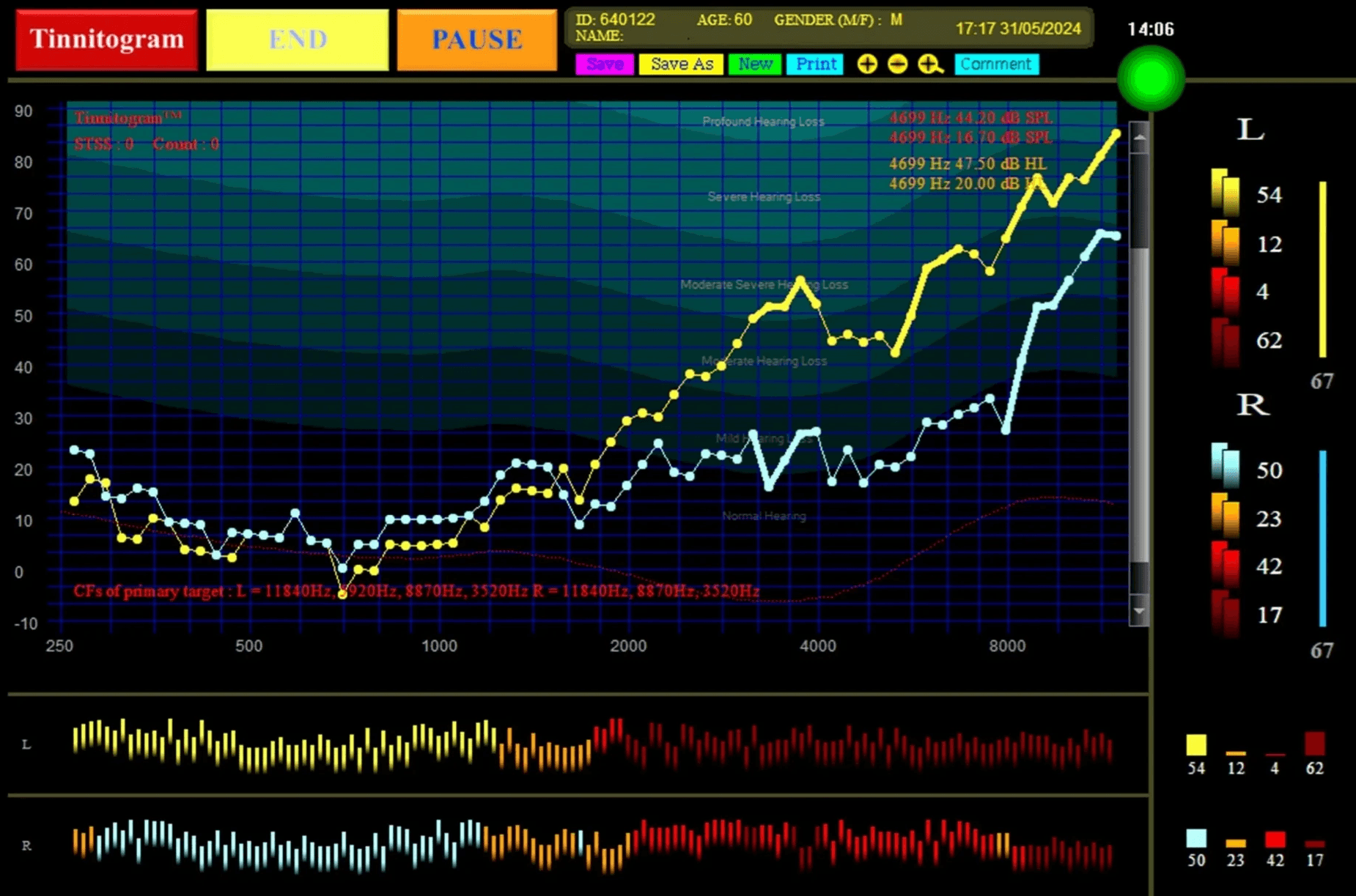
Much of the initial tinnitus evaluation was education, because a patient's understanding of why a therapy works is itself a meaningful predictor of success. A standard hearing test measures roughly eight frequencies. The Frequency Health protocol starts with a TinnitogramTM, a unique auditory test that maps the hearing spectrum in far finer detail with 67 frequencies. Conducted in a soundproof booth over about fifteen minutes, it identifies the four center frequencies driving the tinnitus in each ear.

"When we can pinpoint exactly where in the frequency range the tinnitus is stemming from," Dr. Prutsman explained, "we can stimulate the affected areas of the inner ear precisely, at a low level, and precise stimulation is more likely to produce a response."

For Brad, the logic landed. "When you explain how it breaks the hearing spectrum into more segments so you can target the areas of concern, that made sense to me. I thought, what do I have to lose?"

Brad's treatment and timeline

From the TinnitogramTM, we built Brad a custom sound therapy file, which we loaded onto an MP3 player for daily use. Although he perceived the ringing only on his left side, we stimulated both ears by design. "We never want to shift the perception from one side to the other," Dr. Prutsman noted. "We'd never want a patient to say, 'You helped my bad ear, but switched it over to my good one.'"

A committed patient, Brad chose to use the therapy twice daily, morning and night, timed to when tinnitus tends to be most intrusive. His progress unfolded steadily:

Weeks 1–2

 "It took a week or two for things to adjust," Brad said. "I noticed it gradually lowering in volume, and the longer I did it, the longer the relief lasted through the day."

Month 1

"Before my second visit, my sleep was noticeably better, falling asleep faster, sleeping sounder, sleeping longer. That alone stopped the spiraling I was so worried about." Dr. Prutsman saw the same early signal: "He came in saying, 'I feel like something's happening' that was all positive."

Months 2–3

As later files were fine-tuned, the gains compounded. "Months two and three were where we hit our stride," Brad said. "I'd wake up, and it wouldn't be as loud." By the two-month mark, he was sleeping through the night without white noise or masking.

Throughout, the approach was iterative: re-test, review the tracked measures, and refine the file. Brad came to value the structure. "I looked forward to the appointments to see how much we were improving. When you feel you're going the right direction, that alone gives you relief. I look forward to tomorrow now."
The Outcome

The change was measurable. We tracked Brad's progress using the Tinnitus Functional Index (TFI), a validated 25-item questionnaire scored from 0 to 100 that measures the severity of tinnitus’s impact on a person's daily life. At his first visit, Brad scored a 70, placing him in the most severe category, a "very big problem." By the end of his treatment, that score had fallen to 14, below the threshold for tinnitus being a problem at all. While a drop of 13 points is considered a clinically meaningful improvement, Brad's score fell by more than 50 points.

But the clearest sign of progress wasn't on any questionnaire. "My patient personality is back," Brad said. "I'm making jokes again, things I hadn't done in a long time." His advice to others reflects what most reliably drives success in our experience: consistency and patience. "It's simple, it's not invasive, and you can do it whenever you want. But be religious about it. Give your brain a chance to adapt. In a couple of weeks, you see improvement, and within a couple of months, you think, I can't believe how much better this is.

Frequently Asked Questions

Why should tinnitus in one ear be evaluated with an MRI?

One-sided (unilateral) tinnitus is uncommon and can occasionally indicate an underlying cause, such as a benign tumor on the hearing nerve. Imaging is recommended to rule this out. The likelihood of a finding is low, but the evaluation is important.

Can sound therapy reduce tinnitus?

What is a Tinnitogram?

How long does sound therapy take to work?

Is sound therapy a cure for tinnitus?

*This patient story reflects one individual's experience. Tinnitus is a subjective, highly variable condition, and results differ from person to person. Any new or one-sided tinnitus should be evaluated by a healthcare professional. To learn whether precision sound therapy is right for you, please reach out.


Denver

Fort Collins

Golden

Highlands Ranch

Westminster

Mesa

Peoria

Scottsdale

Boulder

Request a Callback

Have questions about your insurance coverage for tinnitus-related hearing problems?

Complete the form and one of our experts wil be in touch to discuss your options.

Denver

Fort Collins

Golden

Highlands Ranch

Westminster

Mesa

Peoria

Scottsdale

Boulder

Request a Callback

Have questions about your insurance coverage for tinnitus-related hearing problems?

Complete the form and one of our experts wil be in touch to discuss your options.